Our Graduate Programs
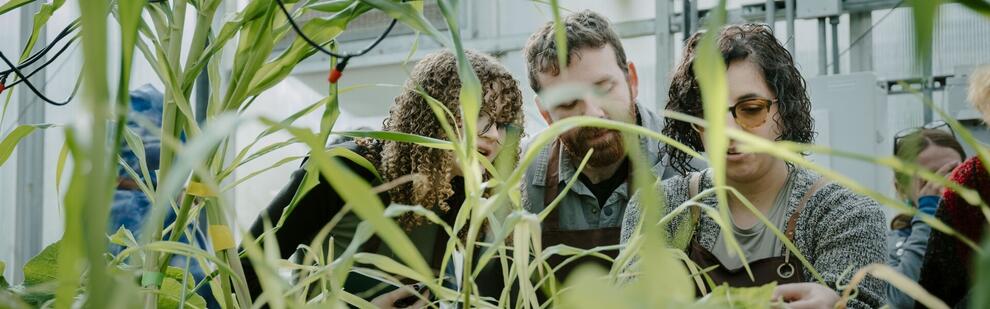
The SFSU Department of Biology provides a rich academic experience for graduate students through hands-on mentored research training, peer collaboration and a rigorous curriculum focused on discussion-style courses and seminars.
Our graduate degree programs are designed to provide an effective springboard to professional careers in academic research, education, environmental consulting, governmental agencies, biotechnology, health professions and more.
SFSU is part of the Western Regional Graduate Program, allowing eligible, newly-enrolled graduate students to pay in-state (California resident) tuition rates. Learn more about the WICHE program here.
Application Requirements
In addition to the general requirements for admission, applicants must submit:
Mentors
To identify potential SFSU faculty mentors, browse the Biology faculty profiles to see what research interests you. Email faculty members whose research fits with your interests and arrange an individual appointment to discuss opportunities in their laboratories. We encourage you to be proactive. You will need to list the names of the faculty member on your application.
Please note that we only admit applicants who have been invited to join the lab of a graduate faculty member.
Find faculty:
- Faculty by research discipline
- California Academy of Science research professors
- Estuary and Ocean Science Center resident faculty
Personal statement:
Prepare a two-page statement of purpose that discusses your interests and goals relating to you pursuing an M.S. in Biology. The essay should be double spaced and 12-point font. You can upload this file as a .doc, .docx, .pdf or .rtf format.
In this essay, please address the following:
- Let us know a little about who you are. This can include where you are from, your upbringing, your educational experiences or relevant stories that help us get to know you.
- Tell us about how your motivation to pursue graduate studies in Biology developed.
- Describe previous research or laboratory experience.
- Describe how participation in our program will benefit your educational or career goals.
- Identify which faculty members whose research matches your interests.
All-science transcripts
You will need to list of all the science courses you have taken on our All-Science Transcript Form.
Letters of recommendation
You need a minimum of two letters of recommendation. Letters can be submitted through the evaluation tab in your application. Alternatively, they may be emailed to biograd@sfsu.edu. Subject line should be “Letter of Recommendation for applicant [Your Name].”
English language requirements
The Department of Biology does not require the GRE General or Subject Test. If you would like to submit your scores, you may do so; however, GRE scores are not used as criteria for admission.
International students should review international graduate student applicant guidelines.
The Division of Graduate Studies minimum TOEFL, IELTS and PTE Academic scores are:
- TOEFL
550 Total score on the paper-based test
80 Overall score on the internet-based test (iBT TOEFL) - IELTS
Overall band score of 7.0 - PTE Academic
Pearson Test of English (PTE) Academic overall score of 65
For applicants who do not hold an undergraduate science degree:
There aren’t an established set of prerequisite courses students must have to apply to our M.A. program. However, we recommend students take the following courses: introduction to biology, inorganic and organic chemistry, cell biology, genetics and either calculus or statistics. It's more important that students have a solid foundation in those subjects.
Applications are due February 1.
Graduate Programs
Master of Science in Cell and Molecular Biology
This program is designed for students preparing for further graduate work as well as those wishing to increase their competency in the fields of cell and molecular biology.
Master of Science in Integrative Biology
The Masters in Biology with a Concentration in Integrative Biology is designed for students aiming to go on to Ph.D. programs or enter the workplace in fields such as systematics, evolutionary biology, conservation biology, population genetics, genomics, taxonomy, biodiversity, and biogeography and/or community, population, reproductive, physiological, and evolutionary ecology.
Master of Science in Biomedical Science: Concentration in Biotechnology
This program prepares students to pursue advanced academic training in life sciences while developing professional workplace skills.
Master of Science in Biomedical Science: Concentration in Stem Cell Science
This program prepares students to pursue advanced academic training in life sciences while developing professional workplace skills.